少林足球
After the desert turns green, harder work begins_我的网站

一 |
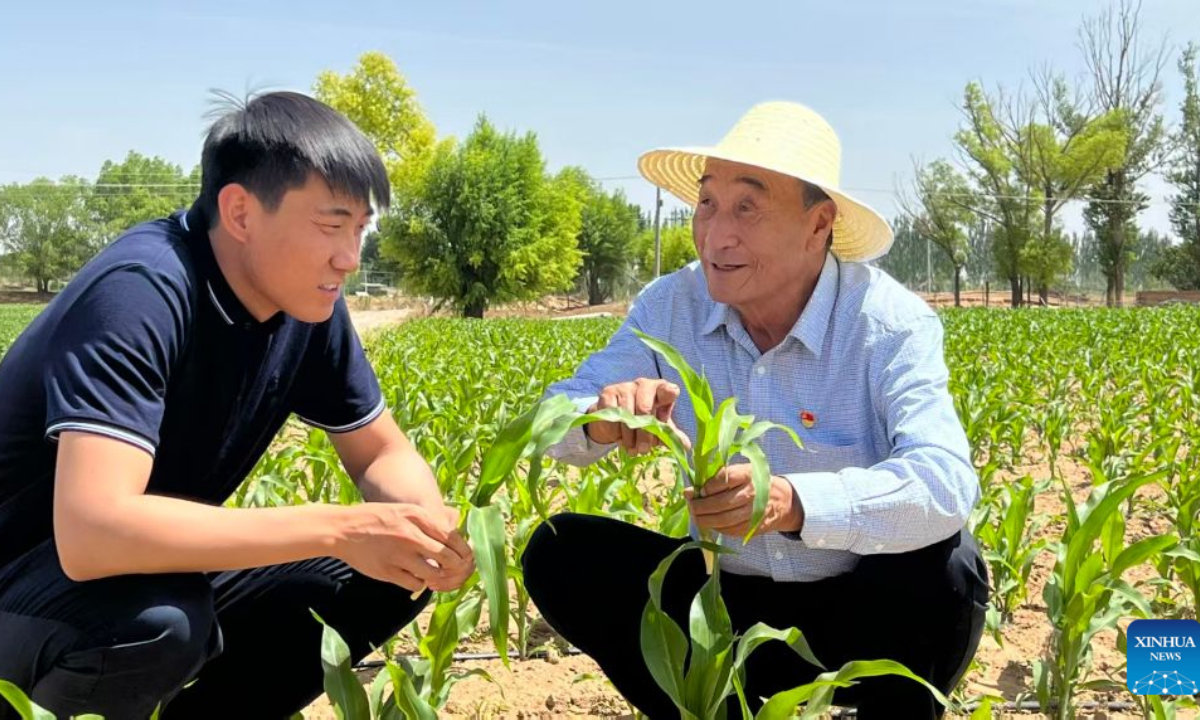
Shi Jianyang (L) and his grandfather check the growth of crops on a farmland near a forest area along the Maowusu Desert in northwest China's Shaanxi Province in 2026.(Xinhua)A drone sweeps above the pine forest, sending images of the woods to a screen below. Under the trees stands Shi Jianyang whose grandfather and hundreds of villagers came 40 years ago with shovels and saplings to stop advancing sand.
At 29, Shi belongs to a new generation of desert-control workers equipped with drones, machines and remote irrigation systems. An earth auger can now do in a day what once required about 200 laborers, while a single phone can control drip irrigation across more than 1,000 mu (about 66.67 hectares) of woodland.
For the older Shi's generation, the challenge was getting trees to survive in moving dunes. For the grandson, it is figuring out how to make those forests healthier and more resilient for decades to come.
Their story captures a broader shift in desert control along the southern edge of the Maowusu Desert in northwest China's Shaanxi Province: turning shifting sand into forest was only the beginning.
In 1986, Shi Guangyin, Shi Jianyang's grandfather, led more than 300 villagers into Langwosha, a sandy area in Dingbian County in Yulin City. He had raised 60,000 yuan (about 17,377 U.S. dollars at the time) by selling his family's 84 sheep and borrowing from relatives and banks to contract 3,500 mu of barren sandy land.
The early setbacks were severe. Strong winds destroyed about 90 percent of the saplings in the first year, and about 80 percent of those planted the following year failed to survive.
After seeking advice from forestry experts, Shi and the villagers laid out checkerboard-shaped barriers on windward slopes to hold the sand in place, then planted trees, shrubs and grasses within them. Sapling survival rates rose to about 80 percent.
Over the next four decades, Shi and those working alongside him treated 250,000 mu of sandy and saline-alkali land, with more than 53 million trees and shrubs taking root.
Greening the Maowusu Desert is part of a much larger national undertaking. It is one of the three major battlefronts of China's Three-North Shelterbelt Forest Program, a decades-long effort to curb desertification across northern China.
China has made desertification control a national ecological priority. Since 2023, the country has stepped up efforts under the program, with greater emphasis on systematic restoration and on consolidating earlier gains.
Decades after the first trees took root, a new challenge emerged. Poplars planted decades ago for their rapid growth began reaching the end of their life cycle, with large numbers of trees dying, while forests dominated by a single species were more vulnerable to pests and disease.
Making a forest was one challenge. Keeping it healthy for another generation is another.
Shi Jianyang grew up watching his grandfather and father work to hold back the sand. His father, Shi Zhanjun, spent years planting trees alongside Shi Guangyin before dying in a road accident in 2008 while transporting saplings.
As a boy, Shi Jianyang sometimes resented the work that had taken his father. He spent summer holidays in makeshift tents in the sandy land, eating meals gritty with sand. During planting season, his father would return home with painful blisters in his mouth.
Yet he eventually chose forestry himself.
After studying forestry technology in university, Shi returned home in 2020 and began working in desert control. His team, initially made up of just seven or eight young locals, later brought in university graduates with expertise in soil science, landscaping and pest control.
The younger generation faced a different question: not simply how to make trees survive, but how to make a forest last.
Shi and his team spent more than 40 days in a 5,000-mu woodland setting up sample plots, measuring rainfall, studying soil microorganisms and tracking tree lodging. They proposed renewing aging forests with better-planned forest structures and expanded the planting of Mongolian pine, a long-lived evergreen species that had been successfully tested locally.
To date, about 50,000 mu of land has been planted with Mongolian pine. As some trees fail to survive and require replacement in subsequent planting seasons, the cumulative area of planting operations has reached about 65,000 mu.
Technology has also changed daily work. Drones patrol forests from the air, mechanized equipment dig planting pits, and irrigation can be managed remotely. Sapling survival rates, which Shi Guangyin's generation had raised to about 80 percent through improved sand-control and planting methods, have climbed further to about 92 percent with greater mechanization and more precise management.
Shi said the changes can be felt on the ground. Strong sandstorms have become rare, winds are weaker inside the forest, and the ground stays moist longer after rain. Summer days beneath the trees also feel cooler, while morning dew appears more often. The changes lead him to rethink desert control.
His approach also reflects a broader effort in China's desert regions to link ecological restoration with local livelihoods, giving communities a stronger economic stake in protecting restored land.
With his grandfather's support, Shi and his team have been looking for ways to make better use of the restored land as ecological conditions improve. They have developed potato seedlings suited to sandy soil, promoted greenhouse farming, and set up a livestock cooperative, while increasingly growing potatoes, watermelons and peppers on land once prone to losing water and nutrients.
Shi has also turned to livestreaming e-commerce to market potatoes and other local farm produce, while developing forest-based health and leisure projects. More than 2,000 local residents have seen their incomes rise steadily as farming, livestock breeding and other businesses have developed.
"We used to fear the sand and keep away from it. Now we understand it and know how to make use of it," Shi Guangyin said. "Today, there are opportunities to make a living everywhere in this sandy land."
Across Yulin, forest coverage has risen from 1.8 percent in 1949 to 34.8 percent, while shifting dunes that once encroached on villages have been brought under control.
For Shi Jianyang, however, the green landscape is not proof that the work is finished. "Planting a tree is not difficult," he said. "The difficult part is looking after it for decades."
The grandfather generation learned how to stop the sand. The young generation is learning how to make what grew there last.
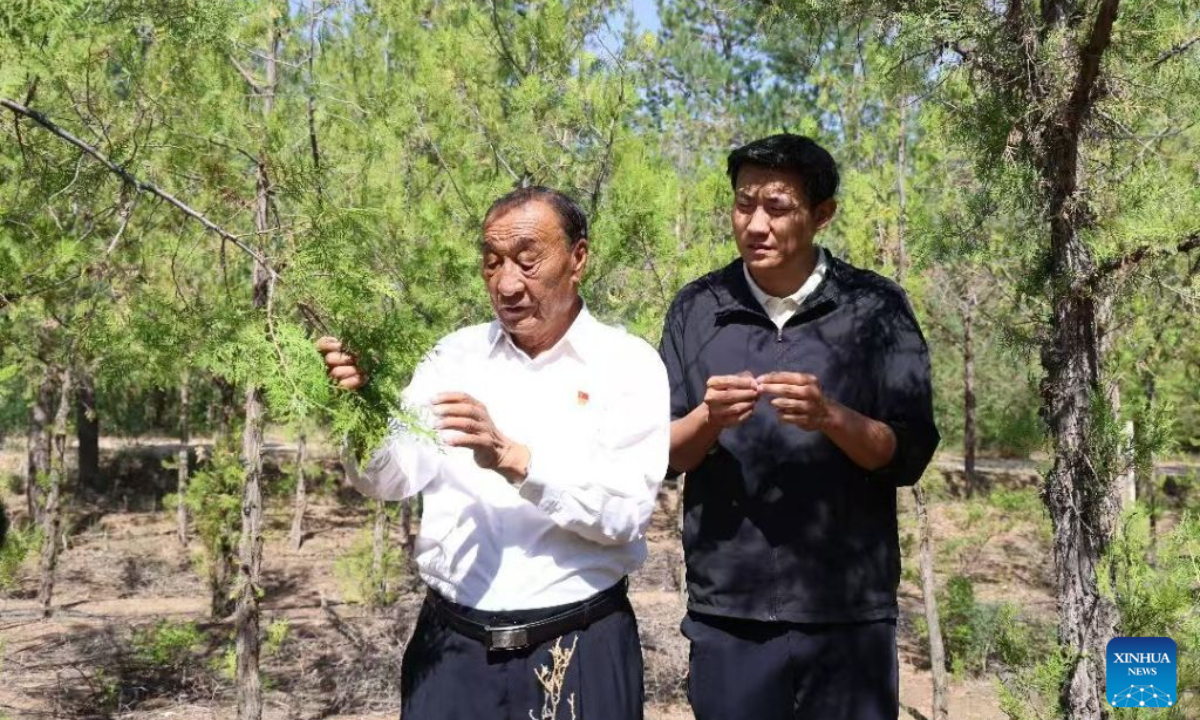
Shi Jianyang (R) and his grandfather check tree growth in a forest area in Dingbian County in Yulin City, northwest China's Shaanxi Province in 2026. (Xinhua)
。
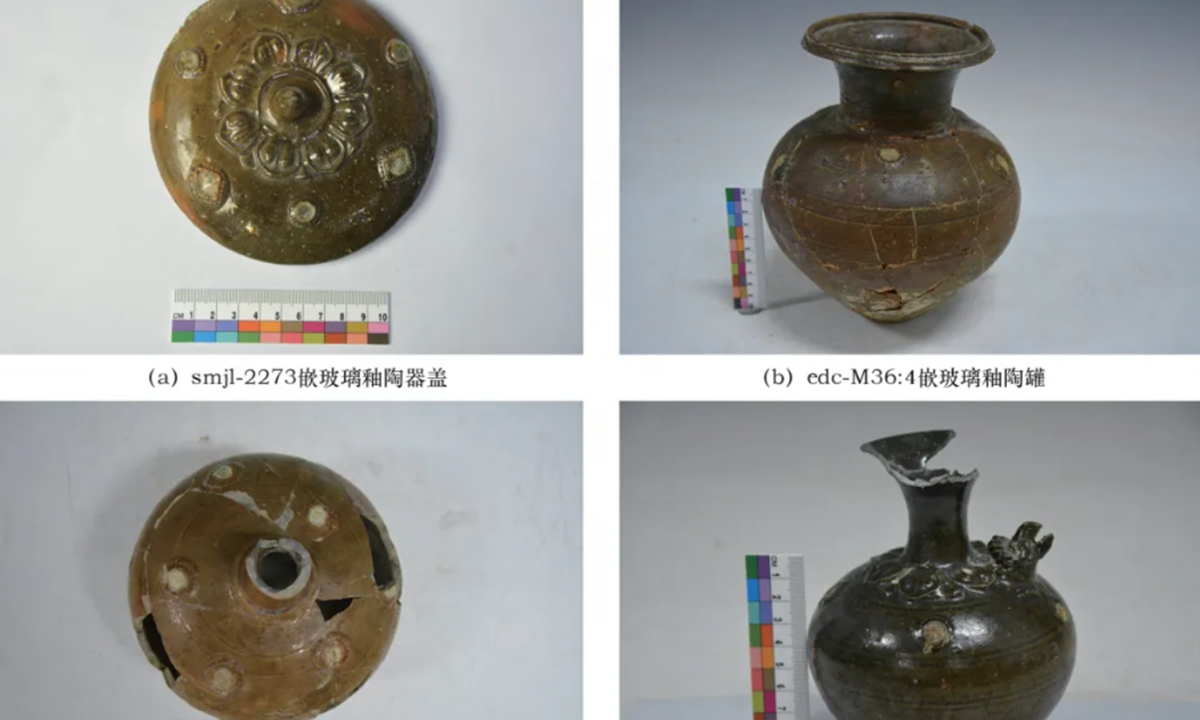
Samples of glazed pottery embedded with glass excavated from Northern Wei tombs in Pingcheng Photo: Courtesy of Shanxi Provincial Institute of ArchaeologyRare glass-inlaid glazed pottery artifacts unearthed from ancient tombs in Northwest China's Shanxi Province have provided new evidence of extensive cultural and trade exchanges between ancient China and other regions more than 1,500 years ago, according to a press release that the Shanxi Provincial Institute of Archaeology sent to the Global Times on Tuesday.
Systematic analysis conducted by the institute of pottery wares dating back to the Pingcheng period of the Northern Wei Dynasty (386-534) has identified distinct foreign cultural and technological elements embedded in the craftsmanship and material composition of the unique artifacts, shedding fresh light on ancient Eurasian cultural integration.
Established by the Tuoba Xianbei ethnic group, the Northern Wei Dynasty designated Pingcheng, present-day Datong city in Shanxi Province, as its capital from 398 to 494. For nearly a century, the city served as a pivotal multicultural hub where Xianbei nomadic culture, Central Plains Han culture and diverse Western Regions civilizations converged and interacted, according to a report on Chinanews.com.cn.
Archaeological excavations at multiple tomb clusters in Pingcheng, including the Dongxin Northern Wei cemetery and the Qilicun cemetery, have yielded a total of eight pieces of glass-inlaid glazed pottery. Though far fewer in number compared with common glazed pottery figurines and painted glazed wares, these artifacts feature an extremely rare inlay technique unseen elsewhere in the developmental history of Chinese ceramics, according to the press release.
Given the exceptional rarity and good preservation of the relics, researchers selected four representative pieces for comprehensive laboratory testing and material analysis. The results show that the glass inlays are primarily soda-alumina glass, most likely produced by remelting trade beads from the Indian Ocean and Pacific regions, a key commodity in ancient maritime and overland trade networks.
The findings confirm that Pingcheng maintained frequent cross-border trade and cultural communication during the Northern Wei era, with access to glass raw materials sourced from diverse overseas regions. The varied compositional characteristics of the inlaid glass provide crucial clues for studying ancient glass-making technologies, raw material circulation and long-distance trade routes in ancient East Asia, the press release noted.
Beyond material composition, the artifacts also embody prominent cross-cultural innovation in design. Their decorative motifs draw heavily on gem-encrusted gold and silver wares of the Sasanian Persian Empire, while integrating artistic elements from other Eurasian regions. The blended design styles reflect the era's prevailing trend of multicultural fusion and creative assimilation of foreign civilizations.
Archaeologists noted that the glass-inlaid glazed pottery represents an innovative technological achievement crafted by Northern Wei artisans who absorbed and refined foreign techniques and aesthetics. The distinctive craftsmanship and stylistic features of these wares exerted a far-reaching influence on ceramic production in surrounding regions and subsequent dynasties, marking a vital chapter in the evolution of ancient Chinese ceramic art.
The research underscores that ancient China's northern borderland was not an isolated cultural enclave, but an active node in Eurasian cultural and trade exchanges, where foreign elements were localized and innovated to form unique regional civilizational achievements, archaeologists from the Shanxi Provincial Institute of Archaeology said.
。
Current article:http://y42y.wenwancaomohenenqiongpangshun.bond/142t/lhq92.html
Published on:16:27:20